Sundt and Growth of Wealth

One of the most common and dangerous misconceptions we hear about ownership in a construction company is that it’s all about perks owners get.

D. Brown Management Profile Picture
Share

Perk (/pərk/) noun:  Abbreviation of perquisite - money, goods, or other benefit to which one is ENTITLED as an employee or as a SHAREHOLDER of a company.
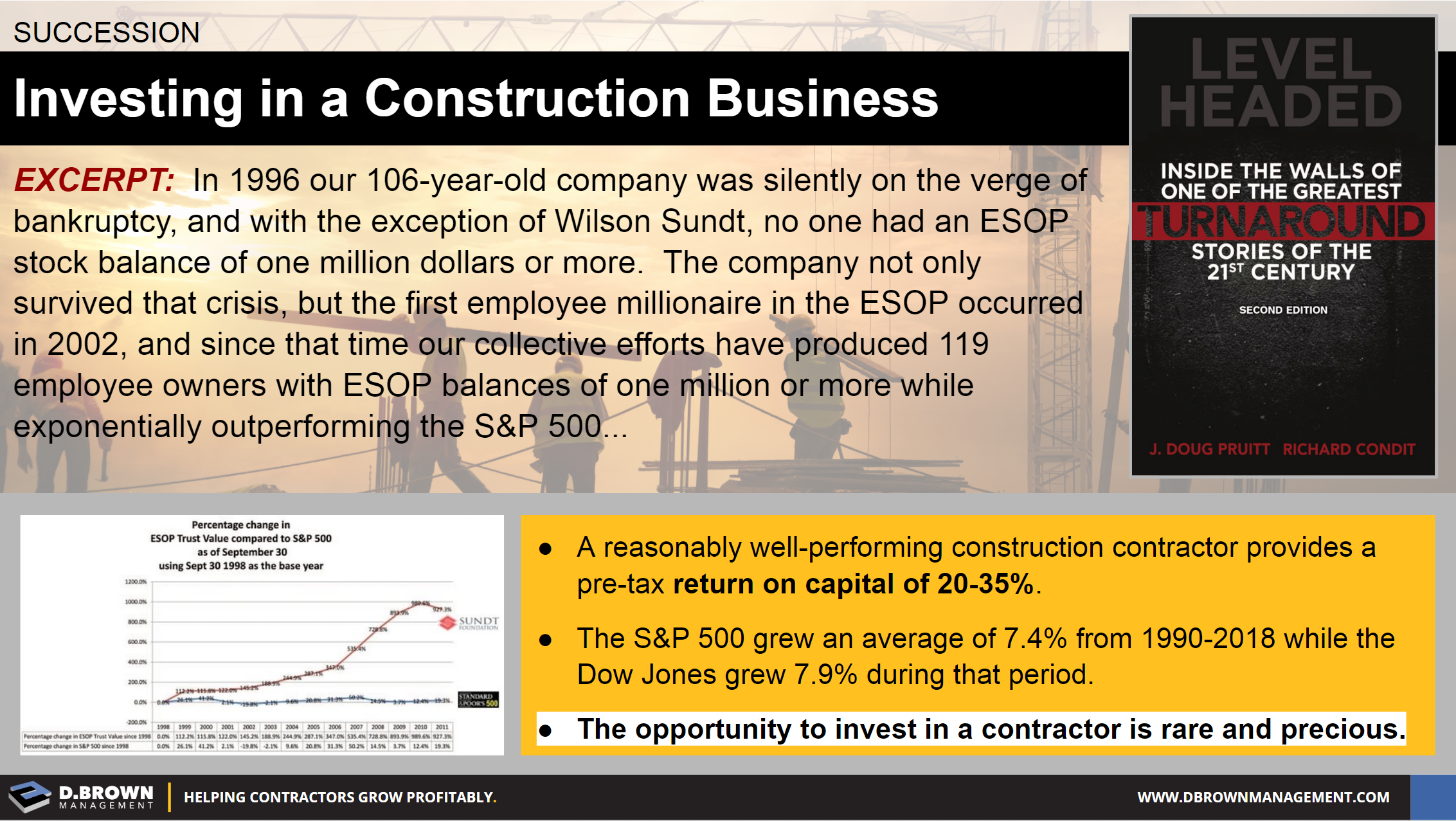
Succession: Investing in a Construction Business. Book: Level Headed, Inside the Walls of One of the Greatest Turnaround Stories of the 21st Century by J. Doug Pruitt and Richard Condit.

  • What kind of vehicle can I get?
  • What kind of expenses can I get reimbursed?
  • What memberships can I get paid for?
  • What travel and entertainment can I get as benefits?
  • How much time can I take off?
  • How big will my office be?  

If these are the questions that come up, they are 100% the wrong level of questions.  

The biggest “perk” to being an owner of a construction company is the opportunity for your money get a 20-35% annual rate of return versus the 8% or so that the market provides.  

Owners who are focused on exploiting that single “perk,” viewing it more as a privilege, are the ones who will truly outperform in the long run.

Sundt is a great example of this alignment


Ownership Transition and Capital Basic Model
When a contractor goes through an ownership transition, the business itself is the proverbial goose laying the golden egg. Remember the basic math formula for ownership transitions and use this simple calculator as a starting point.
Contractor Business Model: Evolution with Stages of Growth
As a contractor navigates the different stages of growth, the complexity of their business model evolves, including their organizational structure, management systems, and people. Seeing this model visually helps identify bottlenecks and constraints.
Building a Systems Development Team - Balance
Striking a balance between immediacy and scalability is a constant decision with Systems Development and will be ever-changing in most organizations. The needs of your organization may necessitate erring on one side of that balance or the other.