Seven Drivers of Valuation

A significant number of contractors will be going through an ownership transition during the next decade.

D. Brown Management Profile Picture
Share

These transitions impact many people, especially the owners and the management teams.  
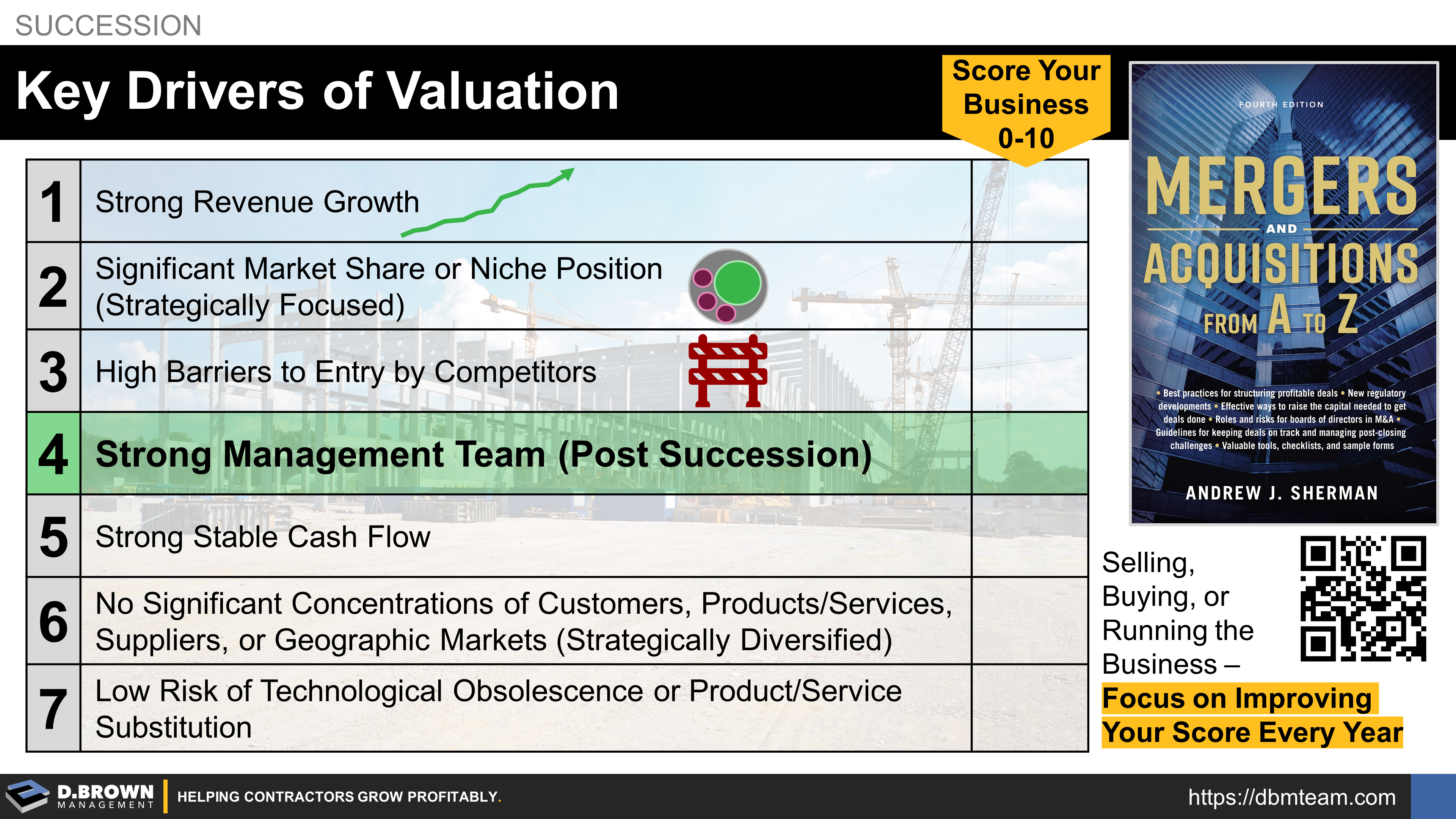
Succession: Key Drivers of Valuation. Book: Mergers Acquisitions From A to Z by Andrew J. Sherman. 1. Strong revenue growth.  2. Significant Market Share or Niche Position  (Strategically Focused)  3. High Barriers to Entry by Competitors.  4. Strong Management Team (Post Succession).  5. Strong and stable cash flow. 6. No Significant Concentrations of Customers, Products/Services, Suppliers, or Geographic Markets (Strategically Diversified). 7. Low Risk of Technological Obsolescence or Substitution

Valuation is a very critical factor during these transitions because it has to be a number that fairly represents the value of the business for the outgoing owners while providing a solid return for the buyers.  

Andrew J. Sherman just published the Fourth Edition of Mergers & Acquisitions which should be read by anyone who is or could potentially be on either side of a transaction. He laid out 7 Valuation Drivers:

  1. Strong Revenue Growth 
  2. Significant Market Share or Niche Position
  3. Barriers to Entry by Competitors
  4. Strong Management Team
  5. Strong Stable Cash Flow
  6. No Significant Concentrations in Customers, Products, Suppliers or Geographic Markets
  7. Low Risk of Technological Obsolescence or Product Substitution

For a contractor, numbers 3 and 7 don’t typically apply. 

Number 4 - Building a strong management team is the leverage point that makes the other factors sustainable in the long-run and, therefore, truly valuable.  


Focus on building your most valuable asset; a strong management team. 


Our Promises
We love the construction industry. We believe in aggressive business and talent development balanced with conservative operations and financial management. We make six promises to the industry, to our clients, to each other, and to ourselves:
Four Stages of Learning a New Skill
It is impossible for any of us to know what we don’t know. And this is the stage where we all must start at when learning a new skill.
Change Tracking Log & Management
Great change management starts with a good tracking system. The far more important part of change management is the rigorous review process at least 2X monthly with your PMs that will limit your risk, increase your opportunities, and train your team.