
This applies to the construction of a project, the building of a contracting business and to life in general.
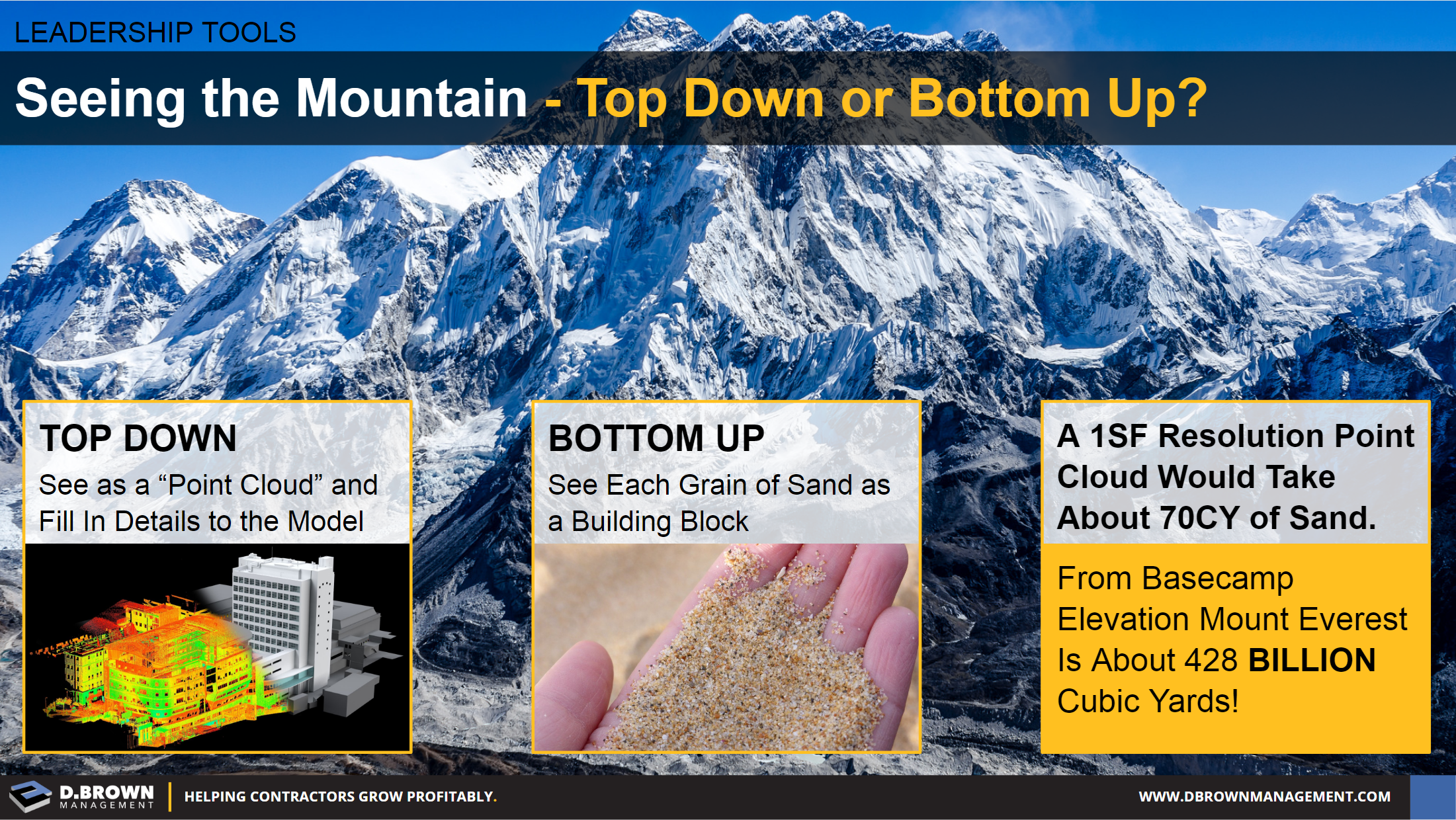
Whether you see the “Big Picture” or the “Operational Minutia” matters little. It is the ability to rapidly zoom in and out as the situation dictates that makes the difference.
Looking at Mount Everest as an example. From basecamp one level and radius the mountain is about 428 billion cubic yards of material. That would require CAT-740’s dumping material at a 1 minute cycle time around the clock for 25,000 years!
If you built a point cloud at a 1 square foot resolution out of sand it would take 70 cubic yards. For reference this picture is less than 0.001% of that resolution.
It is typically better to start developing your mental model as a bigger picture even if it is fuzzy. You may be trying to climb the wrong mountain and it is much better to see that before starting to fill in the details.
- Use “Good Questions” to fill in details of your model.
- Ask rigorous questions of others to build critical thinking skills.
