Net Profits - Four Major Levers

Increasing net profits for contractors comes down to four major levers that can be pulled.

D. Brown Management Profile Picture
Share
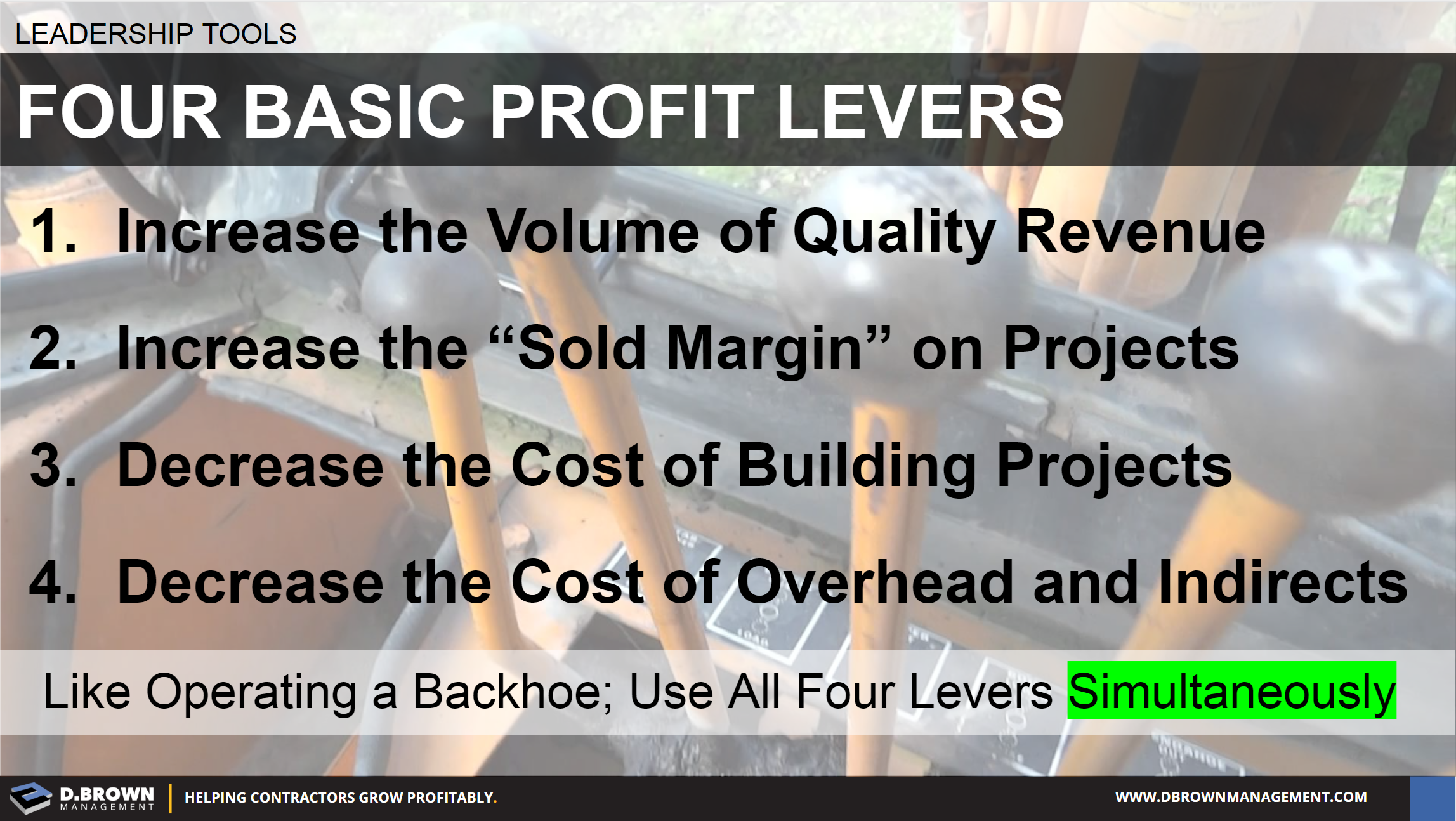
Leadership Tools: Four Basic Profit Levers. Like operating a backhoe; use all four levers simultaneously.
  1. Increase quality revenue up to the point where it stretches your operational capacity.  Not revenue for the sake of revenue but revenue in alignment with your market strategy and capabilities.  Not stretching to the point of breaking but just enough to allow you to grow. 
  2. Increase the “Sold Margin” on projects by finding the customers that will pay the most for the capabilities that you have and by building capabilities that the market places a higher value upon like advanced preconstruction services
  3. Decrease the cost of building project through investments in talent, training, process streamlining, tools and technology.  
  4. Decrease the cost of overhead and indirects in both absolute dollars by looking at every cost and asking how it truly adds value to the customer.  Be careful not to “over-cut” and create a hollow organization that will impact future growth.  

All are interrelated and seem simple on the surface. 


A 3rd party perspective can be helpful for assessment and planning purposes


Competency and Compensation
A large part of sustainable growth for contractors is being able to effectively leverage people with a narrower set of skills to still deliver the same level of value-add to the customer.
Work Conversion Cycle and Backlog Run-Off
PARADOX: A contractor can’t focus on the bigger strategic issues until they have a predictable backlog of work. If a contractor doesn’t have a solid market strategy and organizational structure in place it’s very difficult to build a consistent backlog.
Lean Principle - 3 Enemies of Lean
Profitable growth comes from operating within a target capacity and capability range - and continually increasing those ranges. Operating with consistent overload, consistent under capacity, or with consistently high variability is not sustainable.