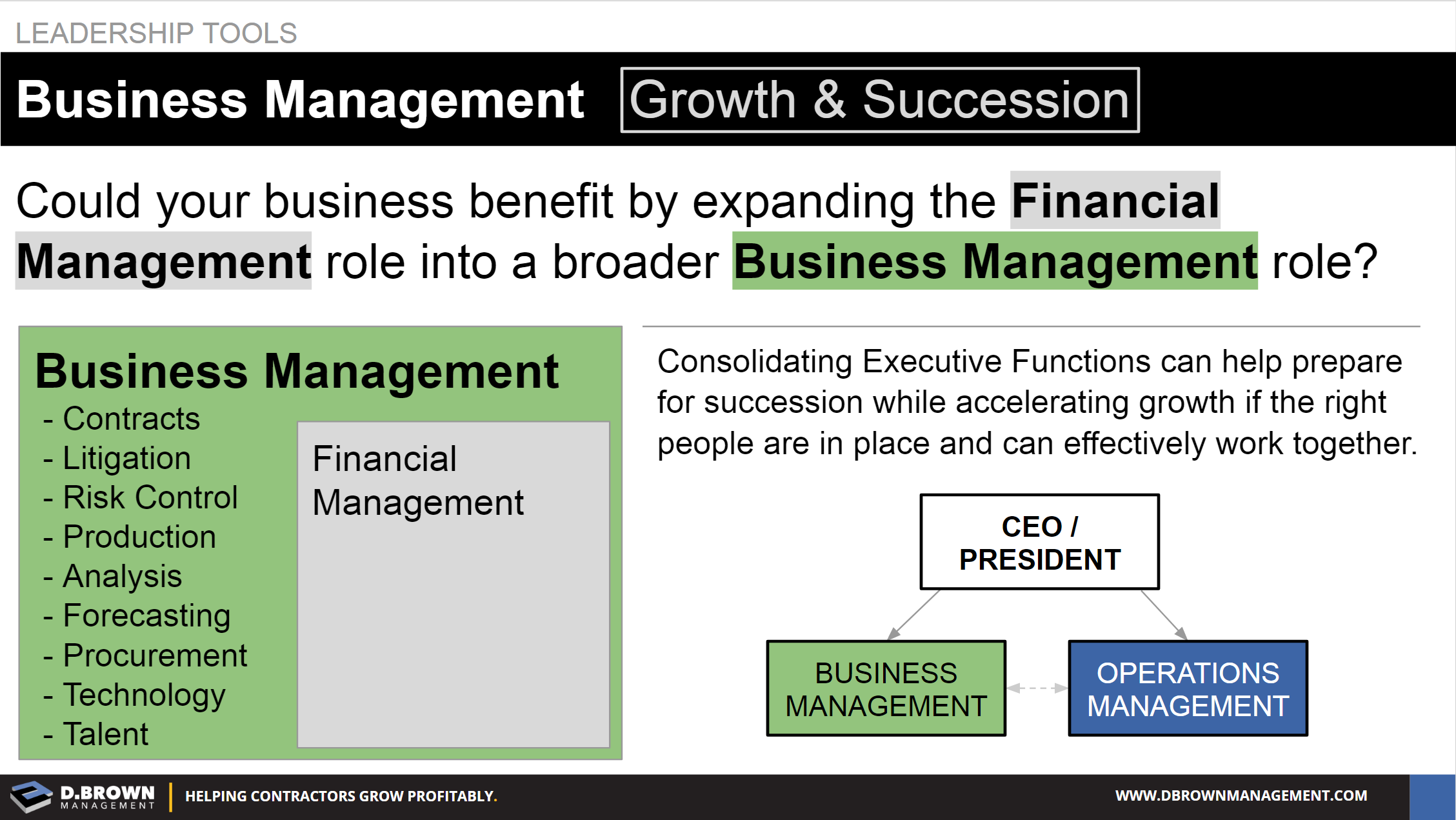
From Financial Management to Business Management

As contractors go through different stages of growth it often makes sense to expand the financial management role into more comprehensive business management role.

D. Brown Management Profile Picture
Share
Leadership Tools: Financial Management to Business Management.

At exactly what stage a contractor starts to expand this role depends on:

  1. Volume or work
  2. Complexity of work
  3. Complexity of the regulatory environment the contractor operates in
  4. Best Return on Time for other operating executives who are currently doing these functions

Of all these the best Return on Time for other executives is often the most overlooked.  Consider how much time some of these functions take other people in the organization.

Could their time be better spent:

  • Connecting with customers to help develop business?
  • Improving project execution?
  • Spending more time developing talent to build capacity for the future?

A fifth major factor includes succession - sometimes the owner/operator of the company is doing so many of these functions or managing so many direct reports that a clean succession is nearly impossible.  


Schedule a call with us to see if this makes sense for your organization


How Effectively Do You Ask for Help?
Effectively asking for help is one of the most important skills you can build for your own development. Developing a team culture where everyone is comfortable asking for help and helping others is a critical leadership skill.
Observe, Hypothesize, and Experiment
Contractors would run much better, including improved field productivity, if they applied the simple lesson we all learned around middle-school science class: Stop debating and start experimenting.
Contractor Exit Strategy 6 of 6: Sale to Employees (ESOP)
Contractor Exit Strategy 6 of 6: An ESOP (Employee Stock Ownership Plan) is a qualified defined contribution employee benefit plan designed primarily to invest in the company’s stock.