Allocation of Management Resources

Most new initiatives that contractors try often fall short of expectations due to poor management time allocation during start-up.

D. Brown Management Profile Picture
Share

We work with a lot of contractors and rarely see truly bad ideas or teams that truly can’t execute.  
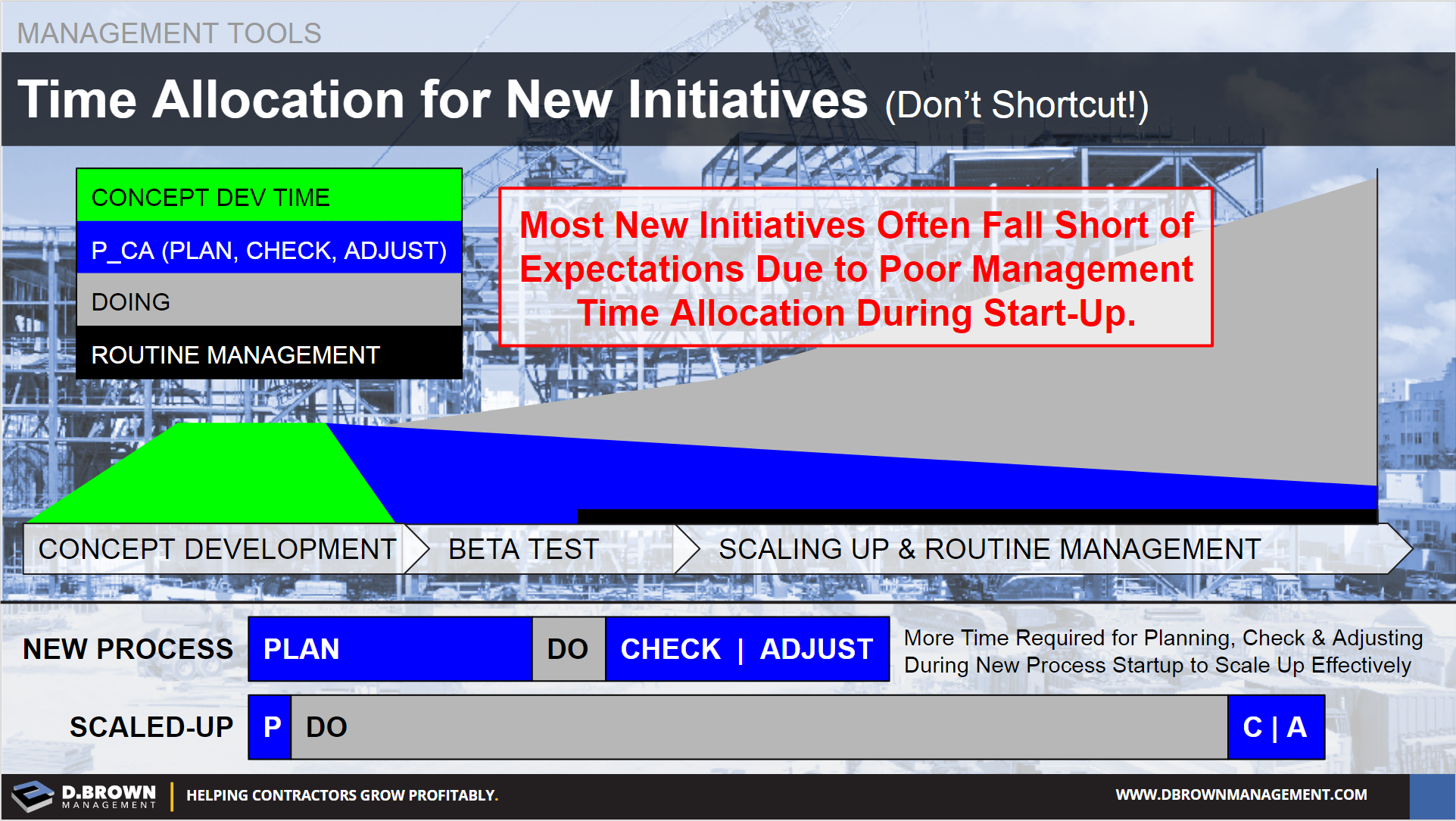
Management Tools: Time Allocation for New Initiatives.

The more common problem is usually management resource constraints; especially at the critical executive leadership level.  When a new idea (or problem) comes up the best management talent can see both the mountain top, the mountain and the path to success very clearly.  

Moving from a new idea into a sustainable system managed mostly by others is the challenge.  Make sure you prioritize management time effectively on the initiatives that will have the biggest impact.   

  • Allocate enough time for truly developing the concept ensuring that the team that will be start-up and long-term management are fully in alignment.  This ALWAYS takes longer than expected
  • Allocate 2-4X that much time for heavily managing the PDCA cycle in the first 3-6 months spending a lot more time Planning, Checking and Adjusting than Doing.  This will ensure smooth scaling and easier routine management.

Learn more about how we help teams learn to execute better 


Leadership Spotlight - The Diffusion and Multiplication of Perceived Behaviors
As a leader, you are always under the spotlight and must behave that way. All of your actions and perceived actions will be replicated throughout the organization. They will not be replicated in the way that you think.
Four Levels of Integration and Optimization
Operational excellence must be a major component of every contractor’s strategy and baked into their daily behaviors. Optimizing at each of the four major layers requires different levels of thinking, technology, and time span.
Lean Principle - 3 Enemies of Lean
Profitable growth comes from operating within a target capacity and capability range - and continually increasing those ranges. Operating with consistent overload, consistent under capacity, or with consistently high variability is not sustainable.